How Salts Mill Worked
From a bold decision to leave Bradford, through 133 years of alpaca cloth production, to a celebrated rebirth as an art gallery and cultural hub. The full story of the building that made Saltaire.
- Updated March 2026
- UNESCO Site
- 170+ Years
Why Titus Salt moved
Bradford in the 1840s was one of the most polluted cities in England. Wool-combing generated noxious fumes, mills were crammed into narrow valleys, and workers lived in overcrowded back-to-backs with poor sanitation. Epidemics were routine.
Titus Salt had already proven alpaca fibre commercially viable — his fabrics won prizes and the business was growing. But expansion inside Bradford was impractical: he needed modern, well-ventilated factory space impossible to build in the city centre.
He chose a greenfield site at Shipley where the Leeds–Liverpool Canal, the Midland Railway and the River Aire all converged. Canal barges could bring in raw fibre; rail wagons could ship finished cloth across the country; and the river provided water for power and processing. It was logistics as much as philanthropy.
- Escape Bradford’s pollution and disease
- Space for a purpose-built, rational factory
- Canal, railway and river converge at Shipley
- Room to house workers in healthy conditions
The building
Architects Lockwood & Mawson designed a T-shaped plan: the main shed ran 550 feet along the canal, with cross-wings housing separate processes. The scale was enormous — at the time it was one of the largest industrial buildings in the world.
Italianate palazzo detailing gave the mill an unexpected dignity: round-arched windows, string courses, rusticated quoins, and a chimney disguised as a campanile made the factory resemble a Florentine palace rather than a northern mill. This was deliberate — Salt wanted the building to represent ambition and order, not just industrial output.
Reed-fireproof construction separated departments vertically to contain fires, a serious risk in textile mills. Iron columns and beams supported the floors rather than timber, and each department could be isolated if fire broke out.
For a deeper look at the architectural language across Saltaire, see our buildings guide.
How the mill was powered
Water from the canal drove a beam engine. Steam supplemented during low water periods. The engine house sat centrally so drive shafts could reach every department via overhead line shafting.
The mill had its own gasworks, and gas lighting extended working hours well beyond daylight. Later, turbines replaced beam engines, and eventually electric motors took over individual machines — but the central engine house remained the heart of the operation for decades.
What was made
Alpaca cloth was the signature product. Salt had pioneered its commercial use in the 1830s, importing raw fibre from South America and developing techniques to spin and weave it into lustrous, durable fabric. The mill also produced mohair, worsted yarns and blended fabrics.
At peak production the mill employed around 3,000 workers and processed raw fibre shipped from Peru, Bolivia and Argentina. Output went worldwide — Salt’s alpaca won prizes at the 1851 Great Exhibition in London, cementing the company’s reputation. The fabrics were used for everything from clothing to furnishings, and the quality commanded premium prices in European and North American markets.
Salt exhibited alpaca cloth at the Crystal Palace. The quality and innovation drew widespread attention, helping to establish alpaca as a fashionable textile and Saltaire as a name associated with industrial excellence.
Inside the departments
Combing, spinning, weaving, dyeing, finishing: each process occupied its own floor or wing. Workers moved through the building in a logical sequence matching the production chain — raw fibre entered at one end and emerged as finished cloth at the other.
The layout was deliberately rational. Combing rooms separated and cleaned the fibres; spinning floors twisted them into yarn; the weaving shed (the largest single space) held hundreds of looms; and the finishing department handled pressing, folding and inspection. This was an early example of flow-line thinking — a factory designed around the process rather than shoehorned into whatever space was available.
From the archive: industry & production
Browse all →
Insider Magazine Vol 14 no.3 March 2011
Insider Magazine Vol 14 no.3 March 2011 includes feature on Neil Gaydon Chief Executive

Aire Valley Living 2010 Issue 3
A booklet with local information and advertising local businesses
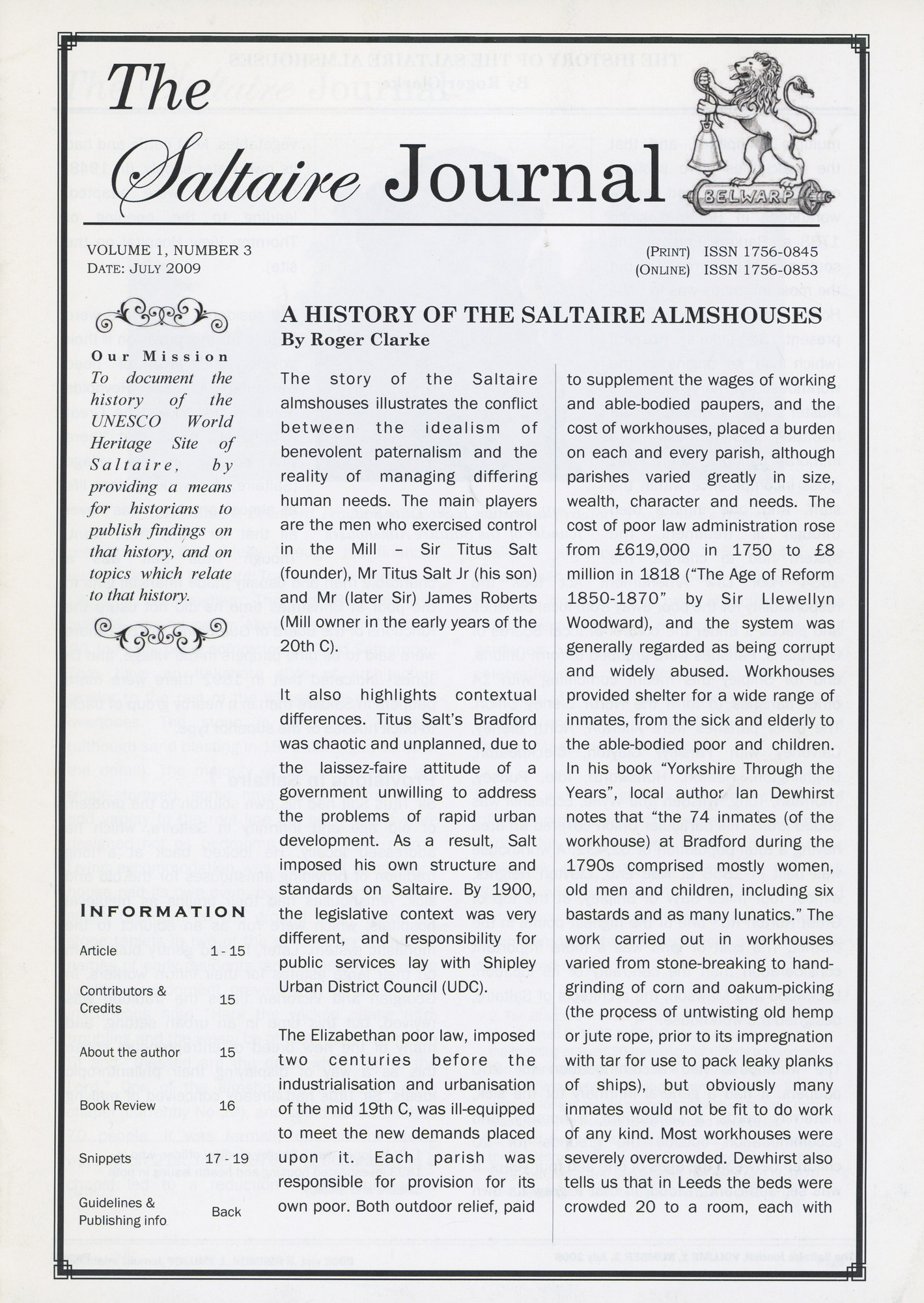
The Saltaire Journal Vol.1 No.3 July 2009. A History of the Saltaire Almshouses
Includes snippets about the Salts Band with photograph, a demonstration of Edison's phonograph at Victoria Hall in 1890, George Salt and a double decker steam t
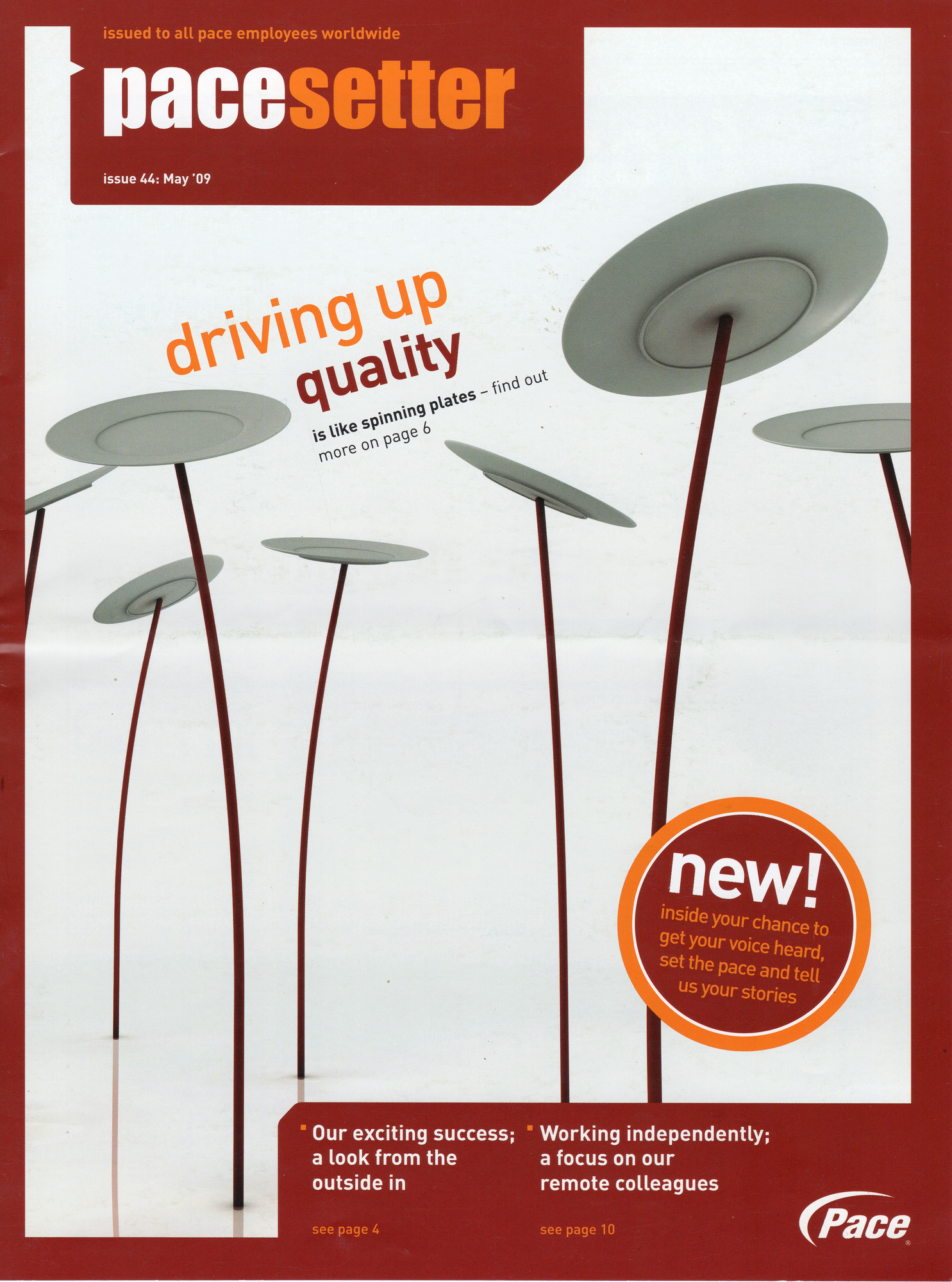
Pacesetter magazine Issue 44, May 2009
Pacesetter magazine issued to all PACE employees worldwide Issue 44 May 2009

Pacesetter magazine Issue 41 May 2008
Pacesetter magazine issued to all PACE employees worldwide Issue 41, May 2008

Pacesetter:Special Edition Pace, here and now : May 2008
Pacesetter:Special Edition Pace, here and now : May 2008 Slim,coloured booklet of 6 pages with fold out cover international map included

Pacesetter magazine Issue 40 January 2008
Pacesetter magazine issued to all PACE employees worldwide Issue 40, January 2008 Articles include 'Pace & Philips' and 'Outsourcing'

Pacesetter magazine Issue 42, September 2008
Pacesetter magazine issued to all PACE employees worldwide Issue 42 September 2008
Working life
The working day started at 6am and finished at 6pm, with a 5:30pm finish on Saturdays. Wages were above the Bradford average, and Salt provided dining rooms, bath-houses and a recreation ground for his workforce.
Fines for lateness were enforced. No pubs were allowed in Saltaire — Salt was temperance, and the village was designed to keep drink out. Workers who fell sick could use the infirmary from 1868, and the almshouses provided for those too old to work.
- Above-average wages for the worsted trade
- Dining rooms and bath-houses on site
- Recreation ground and institute
- Infirmary (from 1868) and almshouses
- Schools for workers’ children
See also: Titus Salt biography
Decline and closure
From the 1890s, cheap imports began to erode the worsted trade. The textile industry that had made Bradford and Saltaire wealthy was shifting — first to cheaper producers elsewhere in England, then overseas. The mill changed hands several times during the 20th century.
ICI’s fabrics division used the building in the post-war period, but the economics of large-scale textile production in a Victorian mill were increasingly difficult. The final closure came in 1986 — the looms fell silent after 133 years of continuous production. The building stood empty and deteriorating, and there was real concern that it might be demolished or left to decay beyond recovery.
Jonathan Silver’s vision
In 1987, local entrepreneur Jonathan Silver bought the derelict mill for a reported £750,000. His plan was bold: art and commerce under one roof. He persuaded his friend David Hockney to show work there, and gradually filled the vast spaces with galleries, bookshops, electronics retailers and a diner.
Silver’s approach was unconventional — he mixed high art with everyday retail, creating a destination that drew visitors and locals alike. The model proved that a huge industrial building could have a viable second life without being carved into small units or converted to housing.
Silver died in 1997, but the model he created survived. The mill remains a working commercial building with a strong cultural identity, exactly as he intended.
- Hockney gave the building international art credibility
- Mixed-use model: gallery + retail + dining under one roof
- Respected the scale of the original spaces
- Drew on local identity rather than generic regeneration
Salts Mill today
The 1853 Gallery houses a permanent collection of David Hockney works — one of the largest publicly accessible collections outside a public gallery. Salts Diner serves food on the gallery floor. Bookshops, home furnishings, fashion boutiques and specialist retailers fill the upper levels.
The building is Grade II* listed and sits within the Saltaire UNESCO World Heritage Site. It is open daily with free entry. Whether you come for Hockney, lunch, or just to stand in a 550-foot mill shed and feel the scale of Victorian ambition, it remains the anchor of any visit to Saltaire.
From the archive: Salts Mill
Browse all →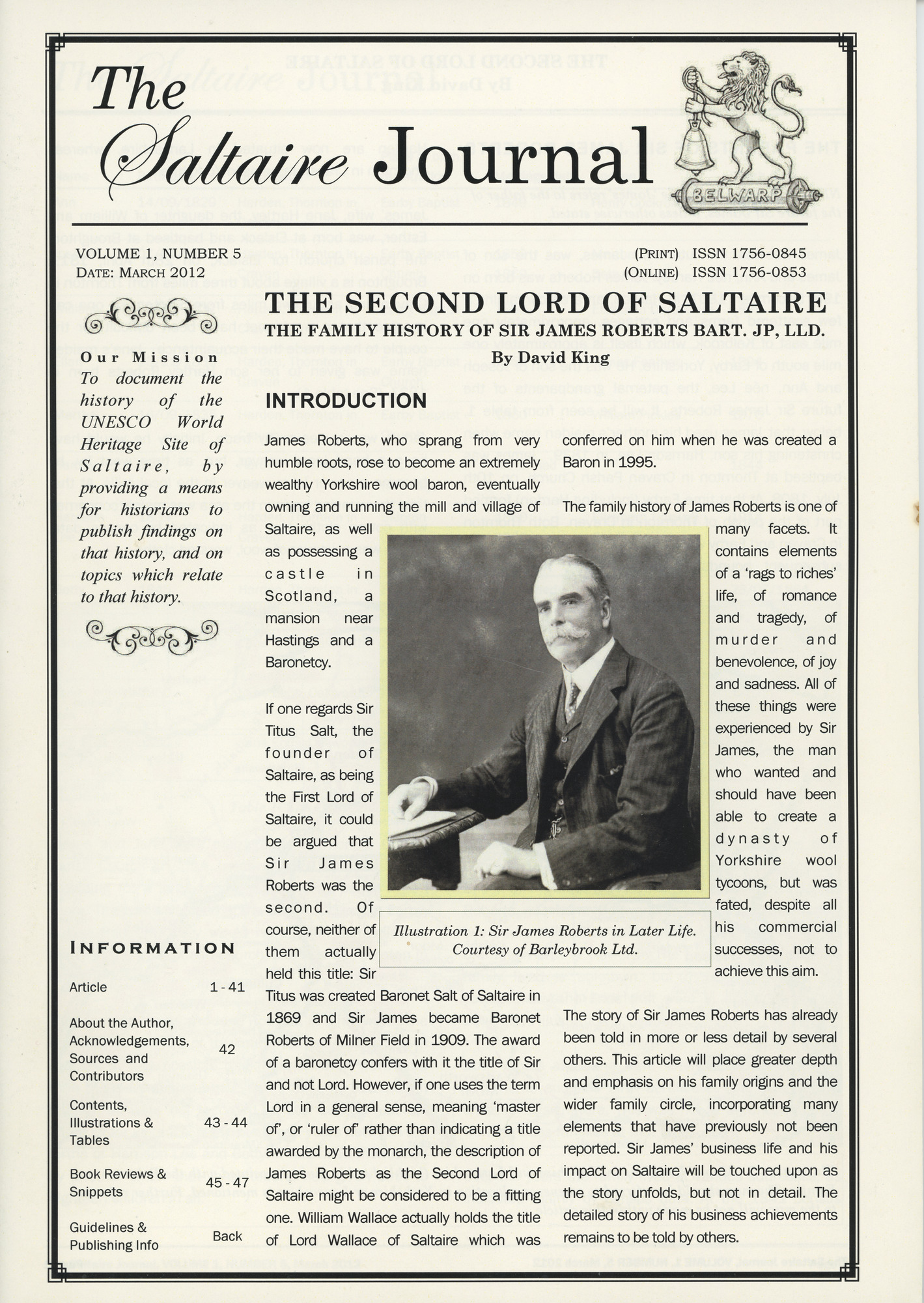
The Saltaire Journal Vol.1 No.5 March 2012 The Second Lord of Saltaire, The Family History of Sir James Roberts by David King.
Includes a snippet about the rally of suffragettes on Shipley Glen 31st May 1908
Insider Magazine Vol 14 no.3 March 2011
Insider Magazine Vol 14 no.3 March 2011 includes feature on Neil Gaydon Chief Executive
Pacesetter magazine Issue 44, May 2009
Pacesetter magazine issued to all PACE employees worldwide Issue 44 May 2009
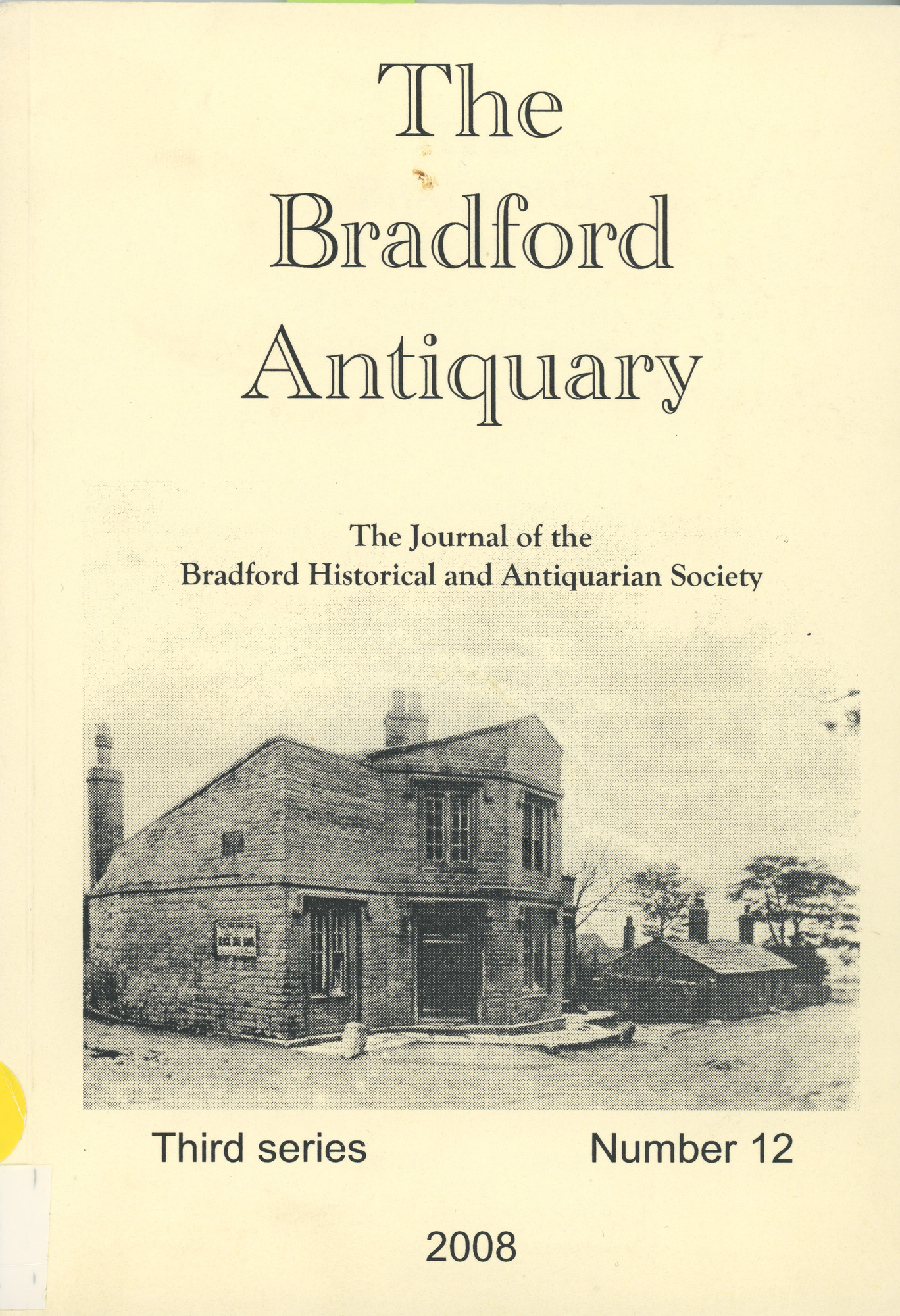
The Bradford Antiquary 2008
The Bradford Antiquary The Journal of the Bradford Historical and Antiquarian Society Third series No.12 2008
Pacesetter magazine Issue 40 January 2008
Pacesetter magazine issued to all PACE employees worldwide Issue 40, January 2008 Articles include 'Pace & Philips' and 'Outsourcing'
Pacesetter:Special Edition Pace, here and now : May 2008
Pacesetter:Special Edition Pace, here and now : May 2008 Slim,coloured booklet of 6 pages with fold out cover international map included
Pacesetter magazine Issue 41 May 2008
Pacesetter magazine issued to all PACE employees worldwide Issue 41, May 2008
Pacesetter magazine Issue 42, September 2008
Pacesetter magazine issued to all PACE employees worldwide Issue 42 September 2008
Quick answers
Q1.When was Salts Mill built?
Construction began in 1851 and the mill opened on 20 September 1853 — Titus Salt's 50th birthday.
Q2.What was made at Salts Mill?
Primarily alpaca cloth and worsted fabrics. The mill also processed mohair and blended yarns, with output exported worldwide.
Q3.Why did Salts Mill close?
Foreign competition eroded the worsted trade from the 1890s onward. The mill changed hands several times before its final closure in 1986 after 133 years of production.
Q4.Who saved Salts Mill?
Jonathan Silver bought the derelict mill in 1987 for a reported £750,000 and introduced art galleries, shops and dining — a model that endures today.
Q5.Can you visit Salts Mill?
Yes, Salts Mill is open daily with free entry. It houses the 1853 Gallery (Hockney), Salts Diner, bookshops and boutiques. See our visitor guide at /salts-mill.
Q6.Is Salts Mill a UNESCO World Heritage Site?
It is part of the Saltaire UNESCO World Heritage Site, inscribed in 2001 for its outstanding example of a mid-19th-century model industrial village.
Sources & further reading
We prioritise primary and authoritative references. If you spot an error, email hello@saltaireguide.uk.
- Historic England — Salts Mill listing (Grade II*)
- UNESCO World Heritage Centre — Saltaire
- Saltaire History Club
- Salts Mill — official site
Plan your visit to Salts Mill
Combine the mill with a walk along the canal, a stop at Roberts Park and lunch at one of Saltaire’s cafes. Our guides keep everything practical and current.